
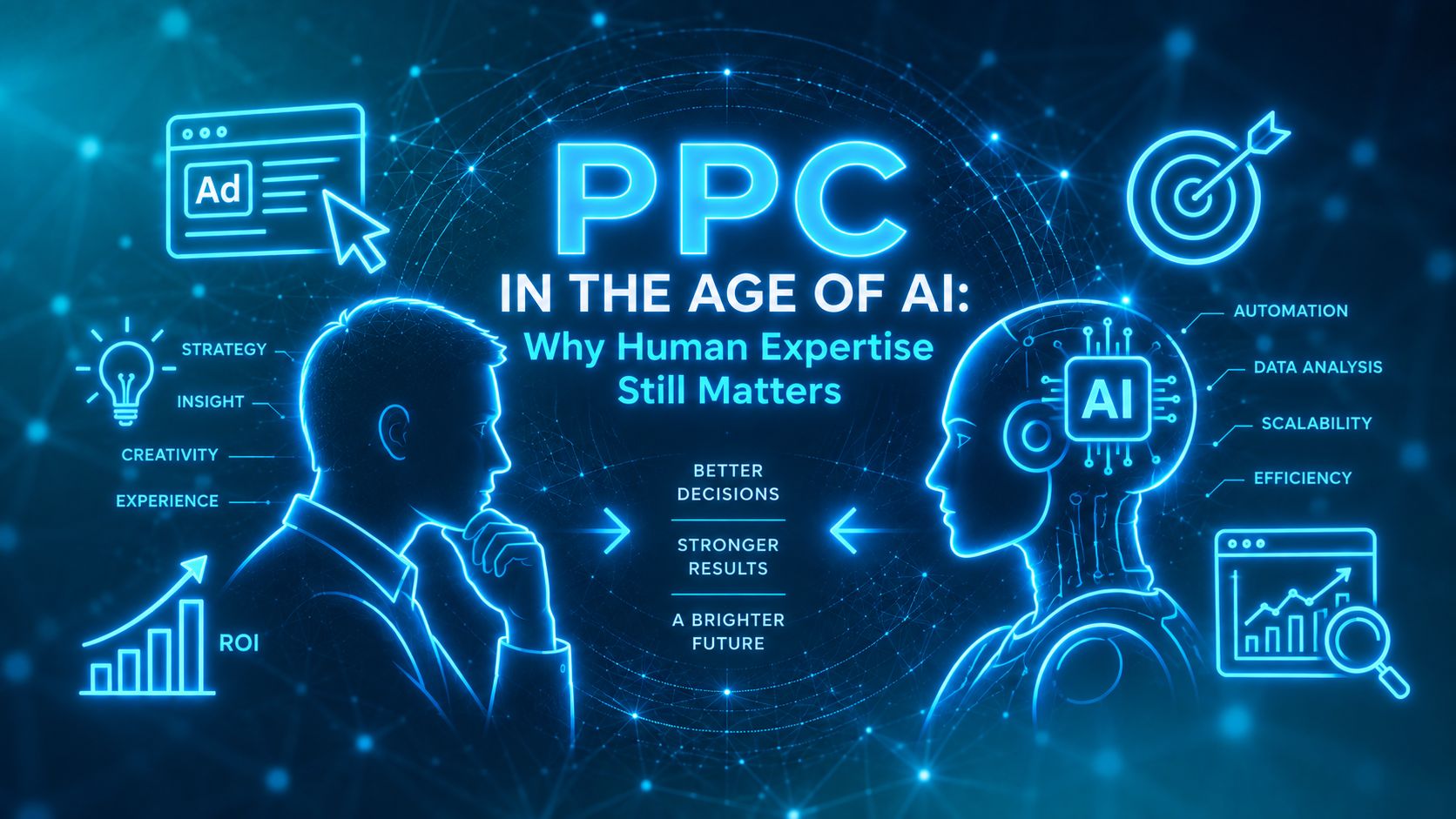
Artificial intelligence is revolutionising almost every aspect of digital marketing, including PPC.
In the last few years, Google Ads has automated its offerings even more. Automated bidding, Performance Max campaigns, AI-generated ads, and AI Max give Google’s technology a bigger role in determining when and where ads are placed.
There are some real advantages for businesses. AI can analyse massive amounts of data, identify patterns, and make changes much faster than what is humanly possible. However, businesses shouldn’t consider automation as a pass to set and forget campaigns.
On the contrary, the rise of AI has, in many respects, increased the importance of the experience and judgement of a PPC management agency. AI can make decisions based on data, but it lacks the understanding of a business and its customers, let alone the commercial goals of the business.
Google Ads Is Automating More
Automation has been present in Google Ads, but the recent changes allow Google to control more of the ads process.
There are forms of automated bidding that will adjust bids based on Google’s estimation of conversion probability. Performance Max campaigns can reach customers across all of Google’s advertising platforms, including Search, Display, YouTube, Discover, Gmail, and Maps.
AI can create and modify advertising content, and AI Max for Search campaigns can use Google AI to go beyond keyword targeting to find other relevant searches. These tools have the potential to revolutionise your advertising. However, keep in mind that the results of an automation process are only as good as the instructions given to that process.
AI Will Never Understand Your Business Like You Do
Google might know a lot about how people behave on the internet, but that’s about it.
You could have ten services but three of them might be generating way better margins. Maybe there’s a certain product that you want to grow, or a service that is already at capacity and you don’t want to receive more enquiries for it. Google will never know those things by looking at your campaign data.
That’s why the other side of AI PPC management is so essential. While AI can do most of the heavy lifting, it’s up to you to provide the directions and to make sure the goals of the business are aligned with the AI’s purposes. Just because a campaign is creating a ton of conversions doesn’t mean it’s a good campaign. It could be creating a ton of conversions for your competitors.
AI can control how money is spent within a campaign, but it can’t control how money is spent for advertising as a whole. Should the advertising budget be allotted to a campaign that is already generating a lot of enquiries? Should the budget be allotted to a new product or service? Is one region bringing in more value than the others?
An experienced PPC management agency can analyse advertising performance in relation to the goals of the business and make changes to budgets accordingly. The goal is not to simply expend the budget. The goal is to spend the budget in a way that brings the most value to the business.
Negative Keywords and Search Terms are Still Important
Google has gotten better at understanding the intent of a user’s search beyond simply matching an ad to a keyword. This can be beneficial to a business as Google may now suggest searches that the business may not have targeted.
However, this can also lead to an irrelevant search causing Google to displayed the business’ ad. Because of this, it is important to continuously review search terms.
Just because a phrase is relevant to Google, does not mean it is relevant to the business and can be used to target the ad. By utilising negative keywords, the business can eliminate relevant, but unprofitable, searches to target and save money.
Well Organised Campaigns are Still Important
Automation does not mean that the Google Ads account can not be organised.
Just because similar products or services exist, does not mean they should be lumped together. Campaigns, ad groups, and asset groups should be organised in a way that helps the business understand and control where the money is spent.
If everything is combined, Google will prioritise the most profitable conversions to make, which may not be in line with what the business wants to promote. A well-structured campaign provides more data for Google’s AI while allowing the advertiser to make broader strategic decisions.
AI-Generated Ads Still Need a Human Eye
Google has introduced features that generate ad elements such as headlines and descriptions, and even suggestions for media. While these can be useful starting points and may even to save time, the advertiser must make the decision as to whether the ad created by the AI is fit to be published.
Does the ad accurately convey the service? Does the ad copy have the tone and voice of the business? Is the information in the ad copy correct? Is the ad copy making any statements that the business is not able to fulfill? These are the things that must be evaluated.
Successful implementation of AI in PPC management means understanding when to leverage automation and when to involve human judgment.
What Happens After the Click is Important too
No amount of persuasive Google Ads can make up for a bad user experience on a website.
Someone can be enticed to click on your advertisement, but if they arrive on a page that is slow, distracting, or simply unrelated to the advertisement, then you risk wasting your advertising budget
The page that the user lands on must be relevant to the advertisement and answer the user’s questions. It must also be designed to facilitate the next step which may be making an inquiry, calling the business, or purchasing a product.
A PPC management agency that focuses on clicks and cost-per-click alone is not considering the advert, landing page, and customer journey holistically enough to determine whether the campaign generated business for the client.
The Future of PPC Is AI and Humans Working Together
We can expect Google Ads to integrate more AI, and that’s something that your business should not be worried about.
Google’s automation can sift through large quantities of data to find opportunities and make changes faster than any human can. However, AI is only as good as the instructions given to it. Humans can fill in the instruction gaps. People can understand a business’s products, services, and the type of customers a business wants to attract, and can also identify what a valuable lead or sale looks like.
Great PPC campaigns are a result of the combination of both AI and human expertise.
At Freetimers Digital, our PPC management team is backed by the latest Google Ads technology. This helps our campaigns cut through the noise and reach your business’s target customers. Our PPC management services can help you maximise your return on investment from Google Ads. Contact us to learn more.